As South Africa observes Child Protection Week from May 29 to June 5, 2025, attention turns to one of the country’s most vulnerable groups—children with special needs. While Child Protection Week traditionally focuses on raising awareness around child abuse and neglect, attention is increasingly being drawn to an often-overlooked issue: the challenges preventing children with disabilities from accessing their fundamental right to education.
Trends in School Attendance
According to the General Household Survey (2009–2024) released by Statistics South Africa, school attendance patterns among children with special needs have shown notable shifts over the 15-year period. The percentage of children aged 7 to 15 not enrolled in educational institutions dropped from 9.8% in 2009 to 7% by 2014, reflecting early progress. However, the percentage increased to nearly 10% in 2015, reversing some of the earlier gains. Although there were fluctuations in the years that followed, the overall trend showed only a slight improvement. From 2022 to 2024, the percentage remained consistently close to 10%, highlighting the challenges in ensuring access to education for children with disabilities.
Provincial Disparities
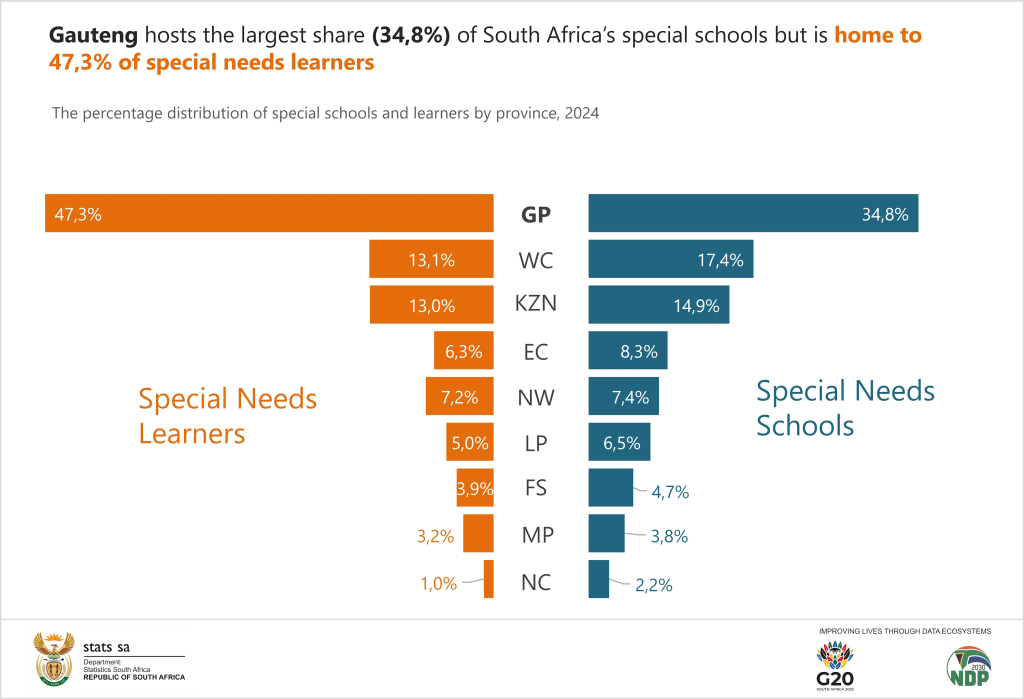
Gauteng hosts the largest share (34.8%) of South Africa’s special schools, according to the Department of Basic Education’s 2024 Education Management Information Systems (EMIS) data. The Western Cape follows with 17.4% of special schools and 13.1% of enrolled learners, while KwaZulu-Natal ranks third, accounting for 14.9% of schools and 13% of learners. Although the Eastern Cape holds 8.3% of special schools, it serves a smaller proportion (6.3%) of learners compared to the North West province with 2.2% of special schools and a proportion of 1.0% of learners.
Full-Service Schools
According to the 2024 Master List of Schools, only three provinces have established full-service schools: Mpumalanga leads with 139, followed by the Eastern Cape with 64, and Gauteng with just 20. In contrast, the country has 554 special schools, collectively serving 172,131 learners.
Provincial Trends in Attendance
An examination of provincial data from 2009 and 2024 highlights meaningful changes in school attendance among children with special needs aged 7 to 15. Although the national average remained relatively steady over the 16-year period, the data reveals considerable differences across provinces.
- The Northern Cape recorded the largest decrease in the percentage of out-of-school children with special needs, with a drop of approximately 13.3 percentage points.
- Free State and Gauteng also reported notable declines.statssa.gov.za+1statssa.gov.za+1
- In contrast, KwaZulu-Natal experienced the most significant increase, with the rate nearly doubling from 8.4% in 2009 to 15.7% in 2024.
- Eastern Cape and Mpumalanga also saw upward trends.
Throughout both years, Western Cape, Free State, and Mpumalanga consistently reported figures below the national average.
Barriers to Learning
While South Africa has made strides in promoting inclusive education, children with disabilities still face significant barriers to learning. These include inadequate infrastructure, lack of trained teachers, and limited access to assistive technologies. Addressing these challenges is crucial to ensuring that all children, regardless of their abilities, have equal access to quality education.
Conclusion
As the nation reflects on the rights and protections of its children during Child Protection Week, it is imperative to recognize and address the educational disparities faced by children with special needs. Ensuring their inclusion in the educational system is not only a matter of equity but also a step towards building a more inclusive and empathetic society.
For more information, visit the Stats SA website at www.statssa.gov.za.